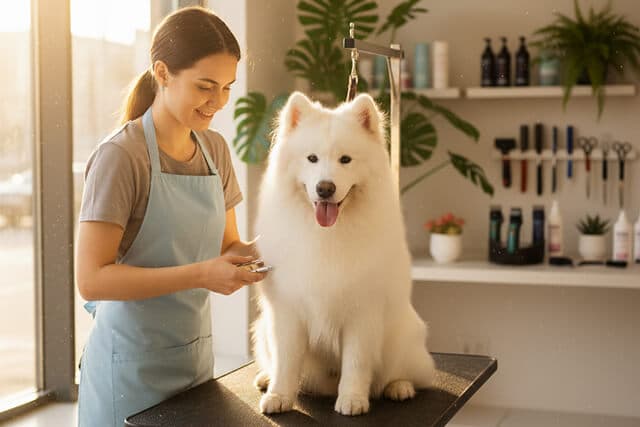
Every coat has a schedule — four weeks for some breeds, eight for others — and every groomer knows the difference between the doodle that comes in on cycle and the same dog arriving at week twelve, matted, for a groom that takes twice as long at the same price.
A loyalty card that lives in the owner's wallet works on exactly that: the stamps reward staying on schedule, and because every visit is scanned, you can see whose cadence is stretching — before it turns into a dematting session, or into silence.
The cycle is health — and revenue
Do the arithmetic on one client: a full groom every six weeks is about 9 visits a year; the same owner drifting to every ten weeks is 5. Same dog, same table — nearly half the revenue, and harder work per visit, because coats that wait get worse. Multiply across a book of a few hundred pets and cadence is worth more than any single new-client promotion. (Estimates — your price list and your book are the real math.)
The good news: unlike most loyalty pitches, this one is genuinely aligned with the customer. A pet on a regular schedule is more comfortable, easier to groom, and cheaper to maintain. The card just makes the right rhythm rewarding.
How the card works at the counter
One QR at the counter. Owners scan it once at drop-off or pickup, and the card lands in Apple Wallet or Google Wallet. No app to install.
One scan per visit. You scan the owner's pass at payment — two seconds while the dog gets its goodbye treat.
Your reward, your menu. Five grooms then a free nail trim, a discounted sixth groom, a free teeth-brushing add-on — whatever fits your services.
What the scans show you
Each client's cadence. Who's on a six-week rhythm and who's quietly slipped to ten — per owner, and across the whole book.
Overdue clients. The six-week regular at week nine is today's most valuable message — for the coat and for the calendar.
Slow-day patterns. Who actually books Tuesdays — and which flexible clients could be nudged off your slammed Saturdays.
New vs returning. Whether the local-Facebook push brought one-off grooms or clients who stuck.
Kardly's numbers are visit-based — scans, members, cycles. No booking-system integration, no pretend revenue dashboards: where money appears in this guide, it's an estimate you can redo with your own price list.
Six mechanics that fit a grooming salon
The classic. Five grooms, then a free add-on or a discounted sixth — keep the reward inside your service menu and it costs you minutes, not margin.
On-schedule bonus. An extra stamp when the next groom lands within the coat's cycle — six weeks for most, four for the high-maintenance breeds. The cadence-keeper, made explicit.
Midweek double. Double stamps Tuesday and Wednesday steer flexible owners toward the empty table days.
Bring-a-friend. A stamp when a member's referral brings their pet in for a first groom — dog-park word of mouth, made countable.
Retail stamp. A stamp on shampoo or brush purchases, if retail is part of your counter.
Win-back. When a regular passes double their usual gap, a friendly note — "time for a tidy-up?" — with a small incentive. Most owners have simply lost track of the weeks.
Set it up between two appointments
Design the card. Logo, colors, stamp count, reward. Ten minutes, self-serve.
Put the QR at the counter. Drop-off and pickup are both calm moments — either works.
Scan at payment. From any phone — works in a salon, and just as well from a mobile-grooming van.
Check the overdue list weekly. Every name on it is a coat getting worse and a slot going unbooked.
Measure it honestly
Watch three numbers over a quarter: members joined, the average gap between visits, and the share of your book that's overdue. Redemptions count too — a claimed free nail trim is proof the loop closes.
Estimate arithmetic: at a €55 average groom, bringing ten drifting clients back from a ten-week to a seven-week cycle is roughly 20 extra grooms a year — around €1,100, before you count the easier coats. An estimate to redo with your own prices — and one your dashboard can verify in a season.
Frequently asked questions
Do owners need to install an app?
No. The card is added to Apple Wallet or Google Wallet from a QR code — wallets their phones already have.
What about families with several pets?
The card lives in the owner's wallet, and every visit is a scan — two dogs on the same day is simply two visits' worth of progress. Multi-pet households reach rewards faster, which is exactly as it should be: they're your best clients.
I already send rebooking reminders — why a card?
Reminders push; the card pulls. It gives owners a running reason to stay on schedule, keeps score visibly in their wallet, and — unlike your reminder list — tells you which clients actually drifted, so your follow-up goes where it's needed.
What does it cost to start?
You can design the card and go live the same day, self-serve — no demo call. Current plans are on the pricing page.
Every coat has a schedule. Put a card in your clients' wallets, and keep the whole book on it.